"His merging of the personal and political, and his quest for new meanings through new and complex juxtapositions of sound and image have ensured that his varied, prolific output has profoundly influenced post-'50s cinema." - Geoff Andrew (Film Handbook, 1989)
Jean-Luc Godard
Director / Screenwriter / Editor / Actor / Producer / Cinematographer
(1930-2022) Born December 3, Paris, France
Top 250 Directors / 21st Century's Top 100 Directors
(1930-2022) Born December 3, Paris, France
Top 250 Directors / 21st Century's Top 100 Directors
Key Production Countries: France, Switzerland, Italy, UK, USA
Key Genres: Drama, Avant-garde/Experimental, Documentary, Essay Film, Psychological Drama, Urban Drama, Short Film, Satire, Culture & Society, Showbiz Drama, Comedy Drama, Crime Drama
Key Collaborators: Raoul Coutard (Cinematographer), Agnès Guillemot (Editor), Jean-Pierre Léaud (Leading Character Actor), Anne-Marie Miéville (Screenwriter/Editor), Alain Sarde (Producer), Georges de Beauregard (Producer), Anna Karina (Leading Actress), László Szabó (Character Actor), William Lubtchansky (Cinematographer), Françoise Collin (Editor), Anne Wiazemsky (Leading Character Actress), Jean-Paul Belmondo (Leading Actor)
Key Genres: Drama, Avant-garde/Experimental, Documentary, Essay Film, Psychological Drama, Urban Drama, Short Film, Satire, Culture & Society, Showbiz Drama, Comedy Drama, Crime Drama
Key Collaborators: Raoul Coutard (Cinematographer), Agnès Guillemot (Editor), Jean-Pierre Léaud (Leading Character Actor), Anne-Marie Miéville (Screenwriter/Editor), Alain Sarde (Producer), Georges de Beauregard (Producer), Anna Karina (Leading Actress), László Szabó (Character Actor), William Lubtchansky (Cinematographer), Françoise Collin (Editor), Anne Wiazemsky (Leading Character Actress), Jean-Paul Belmondo (Leading Actor)
"Godard 's work poses fundamental questions about narrative. While his first films, such as Breathless and A Woman Is a Woman, have fairly straightforward plots, he gradually moved toward a more fragmentary, collage structure. A story is still apparent, but it is deflected into unpredictable paths. Godard juxtaposes staged scenes with documentary material (advertisements, comic strips, crowds passing in the street), often with little connection to the narrative. Far more than his New Wave contemporaries, Godard mixes conventions drawn from popular culture, such as detective novels or Hollywood movies, with references to philosophy or avant-garde art. The inconsistencies, digressions, and disunities of Godard's work make most New Wave films seem quite traditional by comparison." - Kristin Thompson & David Bordwell (Film History: An Introduction, 2009)
"Godard is the first filmmaker to bristle with the effort of digesting all previous cinema and to make cinema itself his subject. He emerged from the darkness of the Cinémathèque rather than from any plausible biographical background... Filmmaking for Godard is neither occupation nor vocation, it is existence itself. His inescapable dialectic is in terms of cinema and his politics have arisen - disastrously, I think - from cinema theory." - David Thomson (The New Biographical Dictionary of Film, 2002)
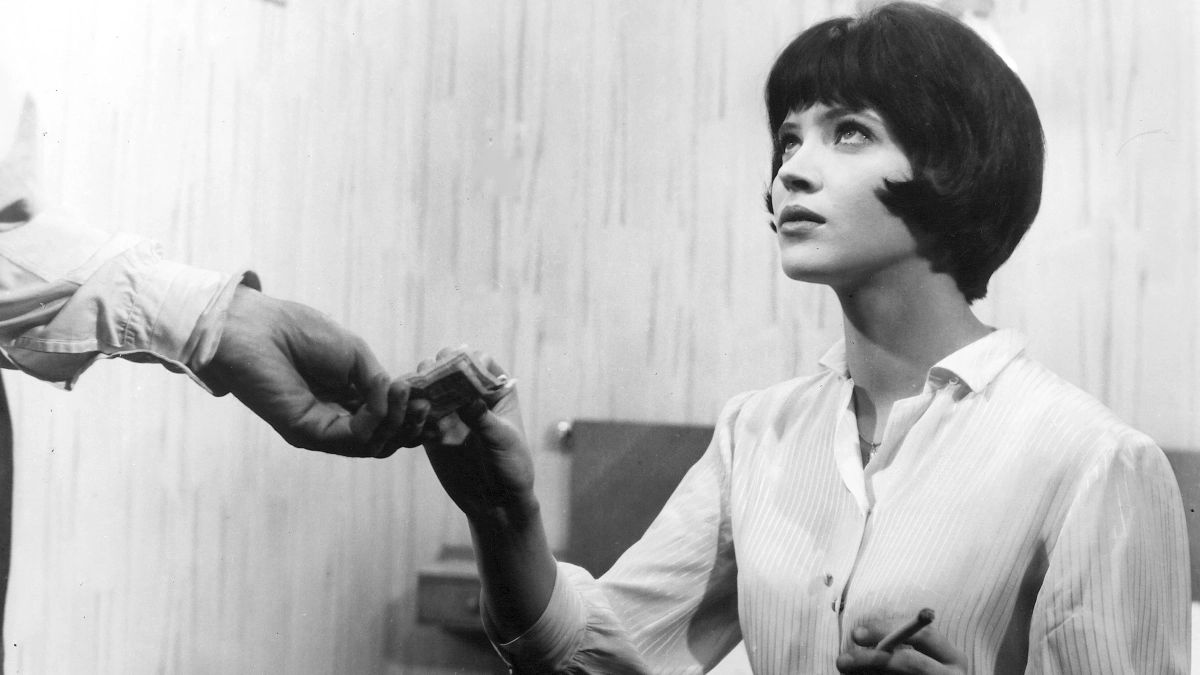
Vivre sa vie (1962)
"Whether he delights or irritates you, Godard sits securely in the front rank of screen originals, and it is good that he succeeded in rejoining the mainstream of French cinema in 1980 after more than ten years' self-exile to its fringes... Nonetheless the quality of his films has been much more variable in recent times compared to his heyday of the 1960s, including a disastrous modernised sideshoot of King Lear." - David Quinlan (Quinlan's Film Directors, 1999)
"His influence on cinematic form and language of the past 60 years has been foundational, but Godard’s best movies are not museum pieces to be studied: They are vibrant, energetic, sexy, full of color and smoke and crepuscular shadows that envelop you… The Swiss-born filmmaker stripped cinema down to its essence — all you need to tell a story on film is “a girl and a gun” he famously said — with a run-and-gun guerrilla style that eventually flowered into a finely wrought formalism." - Christian Blauvelt & Ryan Lattanzio (IndieWire, 2022)
"Godard is as revolutionary and influential a hinge-figure in cinema as Joyce was to literature and the cubists were to painting. He saw a rule and broke it. Every day, in every movie. Incorporating what professionals thought of as mistakes (jump-cuts were only the most famous instance), mixing high culture and low without snobbish distinctions, demolishing the fourth wall between viewing himself as a maker of fictional documentaries, essay movies, and viewing his movies as an inseparable extension of his pioneering work as a film critic for Cahiers du Cinéma in the 1950s." - John Patterson (The Guardian, 2015)
"No one has influenced modern filmmaking more than this French New Wave pioneer. He was one of our greatest lyricists on historical trauma, religion, and the legacy of cinema." - The Criterion Collection
"If influence on the development of world cinema is the criterion, then Jean-Luc Godard is certainly the most important filmmaker of the past thirty years; he is also one of the most problematic... As ex-Cahiers du Cinema critic and New Wave filmmaker, Godard was initially linked with Truffaut and Chabrol in a kind of revolutionary triumvirate; it is easy, in retrospect, to see that Godard was from the start the truly radical figure, the "revolution" of his colleagues operating purely on the aesthetic level and easily assimilable to the mainstream." - Robin Wood and Rob Edelman (The St. James Film Directors Encyclopedia, 1998)
"The political anxieties of the new millennium, from persistent wars on the edges of Europe to the dialogue between the global north and south, find their restless way into films like Notre Musique (2004), Film Socialisme (2010) and his last feature, The Image Book (2018). It’s not all that easy to make out exactly what he wants to say about these things, let alone agree with him. But then, Godard never showed much sign of expecting agreement. His vocation was as an irritant, and long may his exceptional filmmaking remind us of that." - Alison Smith (The Conversation, 2022)
"Godard's impact on the cinema of the 60s was cataclysmal and sweeping and his contribution to the art, thought, and language of the cinema significant. He used the camera not only creatively and inventively, rewriting the syntax of film grammar along the way, but also as a means of personal expression to tell the "the truth 24 times a second"… In removing himself from the mainstream and subjugating his role as an artist to a mission as a political activist, Godard knowingly relinquished his following, along with it his once-considerable influence on the shaping of cinema as a thinking man's art." - The MacMillan International Film Encyclopedia, 1994
"He was the heady verité poet of cinema who busted open our movies from the closed world of the studio system to the flowing existential world around us, with the aesthetics of advertising — slogans, signifiers, propaganda — made as central to life as human emotion (because those things now flowed directly into us; they had become part of us). In doing that, he redefined what the popular medium of movies, going forward, would look and feel like." - Owen Gleiberman (Variety, 2022)
"Godard's critical engagement with form is another constant in his oeuvre, which has remained more radical and experimental than that of any of his nouvelle vague peers. That crucial disjunction between picture and sound (he and partner Anne-Marie Miéville formed a production company called "Sonimage" in the 1970s) i s every bit as central to his films as his politics (which famously swung towards Maoism in the late 1960s), or such recurring themes as prostitution and imperialism." - Tom Charity (The Rough Guide to Film, 2007)
"Everything Godard produces bears his signature and explores his recurringly personal themes. He sought to give cinema a new impetus and direction by harnessing its artistic and social potential. Quips like “The cinema is truth 24 frames per second” and “All you need for a movie is a gun and a girl” may have been a little glib, but they also convey Godard’s passion for his medium and his conviction that it could do more than merely provide a little escapist entertainment. He is the most autobiographical of auteurs, whose pictures are littered with references to films, books, compositions and paintings, as well as the people, places and political ideals that have shaped his personality and psyche." - David Parkinson (BFI, 2018)
"Godard is one of the most important filmmakers in cinema history. He has made audiences think about how films are made in a series of dramatic essays on subjects ranging from the Hollywood gangster film to the musical, the Marxist struggle, and films, filming, and filmmakers themselves." - William R. Meyer (The Film Buff's Catalog, 1978)
"For me, discovering cinema was directly connected to his films. I was living in Paris at the time. When Made in USA opened, I went to the first show - it was around noon - and I sat there until midnight. I saw it six times in a row." - Wim Wenders
"As a charter member of the Nouvelle Vague, Jean-Luc Godard was also arguably the most influential French filmmaker of the postwar era. Beginning with his groundbreaking 1959 feature debut A Bout de Souffle, Godard revolutionized the motion picture form, freeing the medium from the shackles of its long-accepted cinematic language by rewriting the rules of narrative, continuity, sound, and camera work. Later in his career, he also challenged the common means of feature production, distribution, and exhibition, all in an effort to subvert the conventions of the Hollywood formula to create a new kind of film." - Jason Ankeny (Allmovie)
"The cinema is not an art which films life: the cinema is something between art and life. Unlike painting and literature, the cinema both gives to life and takes from it, and I try to render this concept in my films. Literature and painting both exist as art from the very start; the cinema doesn't." - Jean-Luc Godard
"To me style is just the outside of content, and content the inside of style, like the outside and the inside of the human body. Both go together, they can't be separated." - Jean-Luc Godard
"There is cinema before Godard and after Godard." - François Truffaut
Selected Filmography
Loading filmography...
Jean-Luc Godard / Fan Club
David Sterritt, Jonathan Rosenbaum, Amy Taubin, Miguel Marías, J. Hoberman, Kiyoshi Kurosawa, Richard Brody, Nadav Lapid, Fernando Oriente, Susan Sontag, Jean-Michel Frodon, Nicole Brenez.
David Sterritt, Jonathan Rosenbaum, Amy Taubin, Miguel Marías, J. Hoberman, Kiyoshi Kurosawa, Richard Brody, Nadav Lapid, Fernando Oriente, Susan Sontag, Jean-Michel Frodon, Nicole Brenez.
"Fan Club"
These film critics/filmmakers have, on multiple occasions, selected this director’s work within film ballots/lists that they have submitted.
These film critics/filmmakers have, on multiple occasions, selected this director’s work within film ballots/lists that they have submitted.