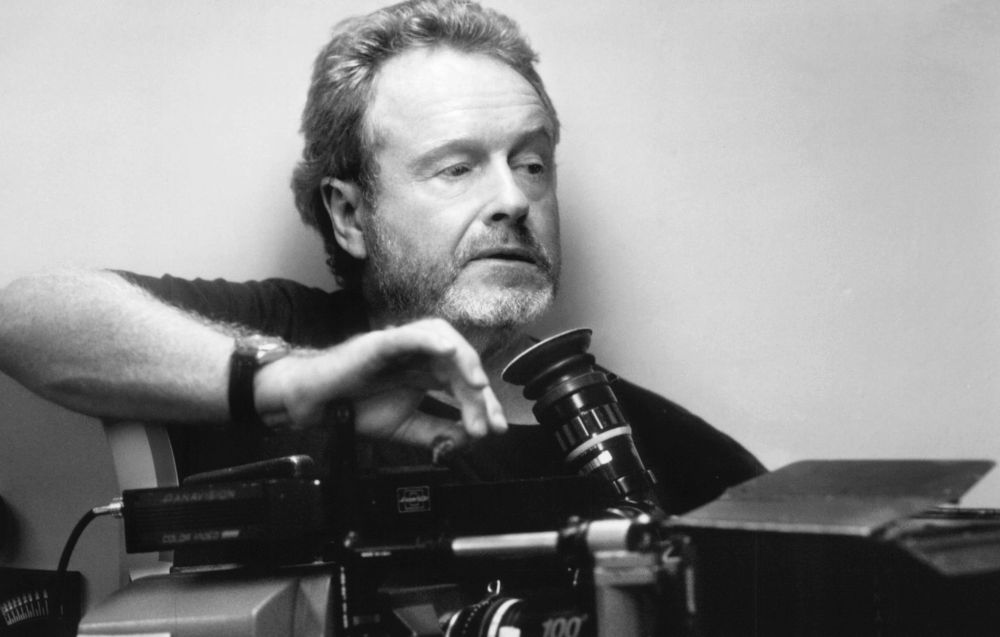
"Detractors consider him a stylish hack, someone capable of dressing up feces. But supporters contend that it is this same talent for rendering the everyday extraordinary that lends him truly awesome storytelling power. Never a shy filmmaker, Scott's cinema reveals characters and situations that are never what they appear at first glance." - Garrett Chaffin-Quiray (501 Movie Directors, 2007)
Ridley Scott
Director / Producer
(1937- ) Born November 30, South Shields, County Durham, England
Top 250 Directors
(1937- ) Born November 30, South Shields, County Durham, England
Top 250 Directors
Key Production Countries: USA, UK
Key Genres: Science Fiction, Epic, Historical Epic, Sci-Fi Horror, Thriller, Sci-Fi Action, Drama, Crime Thriller, Crime Drama, Space Adventure, Alien Film, Action
Key Collaborators: Pietro Scalia (Editor), Arthur Max (Production Designer), Hans Zimmer (Composer), John Mathieson (Cinematographer), Russell Crowe (Leading Actor), Dariusz Wolski (Cinematographer), Marc Streitenfeld (Composer), Norris Spencer (Production Designer), Michael Fassbender (Leading Actor), Walter Hill (Producer), David Giler (Producer), Sigourney Weaver (Leading Actress)
Key Genres: Science Fiction, Epic, Historical Epic, Sci-Fi Horror, Thriller, Sci-Fi Action, Drama, Crime Thriller, Crime Drama, Space Adventure, Alien Film, Action
Key Collaborators: Pietro Scalia (Editor), Arthur Max (Production Designer), Hans Zimmer (Composer), John Mathieson (Cinematographer), Russell Crowe (Leading Actor), Dariusz Wolski (Cinematographer), Marc Streitenfeld (Composer), Norris Spencer (Production Designer), Michael Fassbender (Leading Actor), Walter Hill (Producer), David Giler (Producer), Sigourney Weaver (Leading Actress)
"Directors tend to emphasize different issues in their interpretations of scripts. For a director such as Ridley Scott, masculinity and its habitual need to prove itself is a presence even in his films about women (Thelma and Louise and GI Jane). The value that prevails in a Scott film is the positive value of masculinity." - Ken Dancyger (The Director's Idea: The Path to Great Directing, 2006)
"Though Scott has forged a style that is recognizably his own, his approach to filmmaking has a precedent in German Expressionist filmmaking. The Expressionists were among the first to use the elements of mise-en-scène (set design, lighting, props, costuming) to suggest traits of character or enhance meaning. Similarly, Scott's techniques are stunning yet highly artificial, a trait often criticized by American reviewers, who too often value plot and character over visual style, and realism over symbolism." - Susan Doll (International Dictionary of Films and Filmmakers, 1991)

Blade Runner (1982)
"Although the films Ridley Scott chooses to make suggest a director of considerable ambition, he is unlikely to be taken very seriously until he overcomes an inability to tell a story clearly or to create credible, vivid characters. Too concerned with the look of things, his work is often predictable, even incoherent." - Geoff Andrew (The Film Handbook, 1989)
"For over 45 years, director Ridley Scott has been opening the frame to visions of peerless grandeur, from the historical landscapes of Rome, the Middle Ages, and biblical Egypt to the vast emptiness of outer space and open water to the smog-choked cities of Los Angeles and Osaka, Japan. His facility with genre films was clear in the astonishing one-two-three punch that opened his career — the absurdist swashbuckler The Duellists, the deep-space horror film Alien, and the sci-fi dystopia of Blade Runner — but the true common denominator is a quest for beauty and a gift for allowing a fully realized backdrop to play a dominant role in the storytelling." - Scott Tobias (Vulture, 2021)
"Often derided by critics for his tendency to emphasise style over substance, particularly in the use of inexplicable, though atmospheric, light sources (a quality he shares with his brother Tony), Scott has created a vision of the past, present and, most dramatically, the future, that has influenced a whole generation of film-makers." - Ian Haydn Smith (Contemporary North American Film Directors, 2002)
"What Scott specializes in are blockbusters for grownups: big, accessible, sometimes very loud genre pictures that rarely feel like they’re aiming to entertain every demographic, the way so many studio releases now do. He is not entirely alone in this lane. Christopher Nolan has found great success making popcorn movies that hardly qualify as fun for all ages. Ditto Jordan Peele, whose high-concept horror is adult in violence and theme. But Scott has been doing this for nearly half a century. And even as the industry has become increasingly infantilized, he’s continued to cater to slightly more mature sensibilities." - A.A. Dowd (Digital Trends, 2024)
"Scott is a decorator, a borrower, and a synthesist; like a great machine he contains all striking images and can deliver and fuse them, so long as the product is impersonal… He is a as blithe and versatile as Michael Curtiz, who always made hokum look as good as quality. Scott can find his imagery in 1800 or 1492, in the Dark Ages or the darker future of twenty-first century L.A." - David Thomson (The New Biographical Dictionary of Film, 2002)
"If his decorative pictorial style can produce breathtaking images, on a bad day Ridley Scott is also capable of virtually a parody of the over-designed advertising aesthetic, such as the blossom-strewn fantasy Legend (1985), which at times resembles a commercial for toilet paper." - Ronald Bergan (Film - Eyewitness Companions, 2006)
"The often spectacular visual composition of his work has earned him the nickname 'The Rembrandt of Light'. He owns Shepparton film studios with his younger brother, the director Tony Scott, and despite a career lull during the mid-1990s, is one of the most successful British directors in Hollywood." - Chambers Film Factfinder, 2006
"From his starting point in British television commercials, Scott has risen to become one of the most trusted names on the Hollywood director's circuit." - Mario Reading (The Movie Companion, 2006)
"People say I pay too much attention to the look of a movie but for God's sake, I'm not producing a Radio 4 Play for Today, I'm making a movie that people are going to look at." - Ridley Scott
"Intuition is everything for me. And learning to trust it and listen to your inner voice can only come through experience. If I'm directing, I'll be sitting there on the weekend thinking, 'How do I start the fuckin' movie?' And I'm going around and then I'll get a ding and I'll stop there—like one finger on the Olivetti, but I draw. I start my storyboard. As soon as I've got the first picture on the board, I've already got the page in my head. Voom. It's like a typewriter, but you're evolving on a visual level." - Ridley Scott (DGA, 2010)
Selected Filmography
Loading filmography...
Ridley Scott / Favourite Films
Citizen Kane (1941) Orson Welles, Lawrence of Arabia (1962) David Lean, Seven Samurai (1954) Akira Kurosawa.
Source: BBC: Calling the Shots (2006)
Citizen Kane (1941) Orson Welles, Lawrence of Arabia (1962) David Lean, Seven Samurai (1954) Akira Kurosawa.
Source: BBC: Calling the Shots (2006)
Ridley Scott / Fan Club
Shin'ya Tsukamoto, Ben Wheatley, Alejandro Amenábar, Guillermo del Toro, Scott Derrickson, Mehmet Açar, Chus Gutiérrez, Milan Pavlovic, Carlos Helí de Almeida, Renato C. Gaiarsa, Helmut Fiebig, Jeffrey M. Anderson.
Shin'ya Tsukamoto, Ben Wheatley, Alejandro Amenábar, Guillermo del Toro, Scott Derrickson, Mehmet Açar, Chus Gutiérrez, Milan Pavlovic, Carlos Helí de Almeida, Renato C. Gaiarsa, Helmut Fiebig, Jeffrey M. Anderson.
"Fan Club"
These film critics/filmmakers have, on multiple occasions, selected this director’s work within film ballots/lists that they have submitted.
These film critics/filmmakers have, on multiple occasions, selected this director’s work within film ballots/lists that they have submitted.